Kirchhoff's Voltage Law
The previous page established that voltage is always a difference between two points, and that every circuit is a closed loop. Kirchhoff's Voltage Law (KVL) makes a precise statement about that loop: the voltages around any closed loop in a circuit always sum to zero.
The Law
KVL: The algebraic sum of all voltages around any closed loop is zero.
This is a direct consequence of energy conservation. As you travel around a loop, voltage sources add energy (a rise) and components consume it (a drop). By the time you arrive back where you started, every joule that was added must have been spent. The net change is zero.
In equation form, for a loop with n elements:
where each term is positive for a voltage rise (across a source) and negative for a voltage drop (across a load).
Think of walking a directed graph where each edge has a weight. The total weight of any cycle is zero — the graph is conservative, like a filesystem where moving into a directory and back out leaves your path depth unchanged.
Applying KVL: the LED circuit
The circuit introduced in Circuits and Voltage is a good worked example.
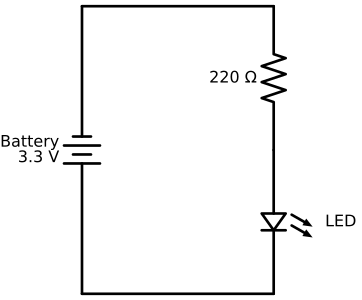
The loop contains three elements:
| Element | Role | Voltage |
|---|---|---|
| 3.3 V supply | Source | +3.3 V (rise) |
| 220 Ω resistor | Load | −V_R (drop) |
| LED | Load | −V_LED (drop) |
Applying KVL:
Rearranging:
This tells you something useful even before calculating: the two drops must add up to the supply voltage. No matter what the individual values are, the supply is always exactly accounted for by the loads.
Filling in the numbers
The LED has a typical forward voltage (V_f) of 2.0 V, so V_LED = 2.0 V:
V_R = 3.3 − 2.0 = 1.3 V
That 1.3 V appears across the resistor. Knowing the resistor value (220 Ω), you can then use Ohm's law () to find the current through the loop:
KVL told you what voltage the resistor sees. Ohm's law then gave you the current. The two laws complement each other.
Voltage Drops Are Additive in Series
KVL has an immediate practical consequence: in a series circuit, voltage drops add up to the supply voltage. If you know the supply and all component voltages except one, you can calculate the missing one by subtraction.
This is how you size a current-limiting resistor for any LED:
- Look up the LED's forward voltage (V_f) in its datasheet.
- Subtract from the supply:
- Pick a resistor:
You are applying KVL in step 2, whether you recognise it by name or not.
KVL With Multiple Loads
KVL is not limited to two loads. Consider a hypothetical string of three components in series from a 3.3 V supply:
| Component | Voltage drop |
|---|---|
| Resistor | V_R |
| LED 1 | 1.8 V |
| LED 2 | 2.1 V |
The supply must provide all three drops:
The negative result immediately tells you something is wrong: a resistor cannot have a negative voltage across it in this configuration. The two LEDs need 3.9 V combined, but the supply only provides 3.3 V. This string cannot work as designed — you need a higher supply voltage or different LEDs. KVL caught the problem algebraically before you wired anything.
Loops, Not Just the Outer Path
KVL applies to any closed loop in a circuit, not just the outer perimeter. In a circuit with branches, every possible loop — including inner loops formed by parallel paths — must independently satisfy KVL.
This means you can pick any loop that interests you and write its KVL equation. If a circuit has multiple loops, each gives you an independent equation, and together they are usually enough to solve for all unknown voltages.
For the circuits in this project — mostly linear series paths from VCC to GND through a single chain of components — there is only one meaningful loop per branch, so this generalisation does not add complexity here.
Where You Will See This in Practice
| Situation | How KVL applies |
|---|---|
| Sizing a current-limiting resistor | V_R = V_supply − V_component_drop |
| Checking whether a series string is viable | Sum of drops must not exceed the supply |
| Reading a datasheet's "application circuit" | Voltage labels on components must sum to the rail voltage shown |
| Debugging unexpected component behaviour | If a component's measured voltage disagrees with what KVL predicts, there is an extra, unaccounted-for drop somewhere (e.g. a bad solder joint with resistance) |
Summary
| Concept | Key takeaway |
|---|---|
| KVL | The sum of all voltages around any closed loop equals zero |
| Voltage rises | Sources (batteries, regulators) contribute positive voltage |
| Voltage drops | Loads (resistors, LEDs) consume voltage; their drops sum to the supply |
| Series circuits | All drops add up to the supply voltage — know any n−1 drops, calculate the last one |
| Impossible circuits | If drops exceed the supply, KVL gives a negative resistor voltage — the design is invalid |