Series and Parallel Resistors
Real circuits rarely contain a single resistor in isolation. Resistors combine in two fundamental ways — series and parallel — each with different effects on the total resistance and how voltage and current distribute across them.
This page assumes you are comfortable with Ohm's law () from Current and Power Delivery and with KVL from Kirchhoff's Voltage Law.
Series Resistors
Two or more resistors are in series when they are connected end-to-end so that the same current must flow through every one of them — there is only one path.
VCC ── [R1] ── [R2] ── [R3] ── GND
The rule
The total resistance is simply the sum:
Why this is true
Apply KVL around the loop. The supply provides V_supply, and each resistor drops part of it:
Because there is only one path, the same current I flows through every resistor:
Substituting:
That is Ohm's law applied to the whole chain, confirming .
Worked example
Resistors of 220 Ω and 330 Ω in series from 3.3 V:
Key properties of series resistors
| Property | Value |
|---|---|
| Total resistance | R1 + R2 (always greater than the largest individual resistor) |
| Current through each | Identical — same single path |
| Voltage across each | Proportional to its resistance |
Parallel Resistors
Two or more resistors are in parallel when both ends of every resistor connect to the same two nodes. Current has multiple paths to choose from.

The rule
The reciprocal of the total resistance equals the sum of the reciprocals:
For exactly two resistors this simplifies to the "product over sum" form:
Why this is true
Both resistors share the same two nodes, so they see the same voltage (V). Each independently draws current according to Ohm's law:
The total current drawn from the supply is the sum (Kirchhoff's Current Law — current into a node equals current out):
Since :
Worked example
Resistors of 1 kΩ and 3 kΩ in parallel from 3.3 V:
Key properties of parallel resistors
| Property | Value |
|---|---|
| Total resistance | Always less than the smallest individual resistor |
| Voltage across each | Identical — same two nodes |
| Current through each | Inversely proportional to its resistance |
Adding a parallel path always gives current more ways to flow, so total resistance always decreases. If you parallel a 1 kΩ with another 1 kΩ, the total is 500 Ω — half. If you parallel a 1 kΩ with a 1 MΩ, the total is ~999 Ω — almost unchanged. A very large resistor in parallel contributes almost no extra path.
Voltage Dividers
A voltage divider is two series resistors used to produce an output voltage that is a fraction of the input.

The output is taken at the midpoint between R1 and R2. Applying the series voltage-drop rule (voltage splits proportionally to resistance):
Worked example
With V_in = 3.3 V, R1 = 10 kΩ, R2 = 10 kΩ:
Equal resistors → half the supply voltage. Change the ratio to adjust the fraction:
| R1 | R2 | V_out (from 3.3 V) |
|---|---|---|
| 10 kΩ | 10 kΩ | 1.65 V |
| 20 kΩ | 10 kΩ | 1.10 V |
| 10 kΩ | 20 kΩ | 2.20 V |
The loading effect
The voltage divider formula assumes nothing else connects to V_out. The moment you attach a load (say, a GPIO pin or another component), that load appears in parallel with R2, reducing the effective resistance at the bottom of the divider and pulling V_out lower than the formula predicts.
To minimise loading error, choose R1 and R2 to be small relative to the load resistance. A common guideline: make the current through the divider at least ten times the current drawn by the load. In practice, 10 kΩ divider resistors work well for high-impedance ADC inputs.
Combining Series and Parallel
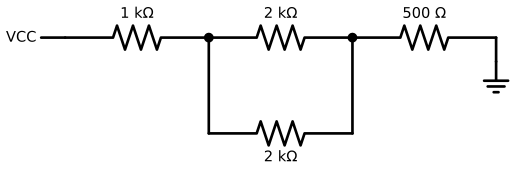
Complex resistor networks are solved by simplifying step by step: find a group that is purely series or purely parallel, replace it with its equivalent single resistor, and repeat until one resistor remains.
Summary
| Configuration | Resistance rule | Voltage | Current |
|---|---|---|---|
| Series | R_total = R1 + R2 + … (always increases) | Splits proportionally | Same through all |
| Parallel | 1/R_total = 1/R1 + 1/R2 + … (always decreases) | Same across all | Splits inversely |
| Voltage divider | Two series resistors | V_out = V_in × R2/(R1+R2) | Watch for loading |
For a practical look at how resistors appear in circuits — including pull-up and pull-down configurations — see Essential Components: Resistors.